
Pine Straw Calculator
Pine straw is a light, attractive mulch that’s easy to spread and knits together on slopes. The main question is how many bales to buy. List your beds, choose a depth and the coverage your supplier quotes for a bale, and this calculator totals the area, bales and cost — and compares it with wood mulch.
- Free to use
- No sign-up
- Runs in your browser
Pine straw calculator
Mulch and Pine Straw Planner
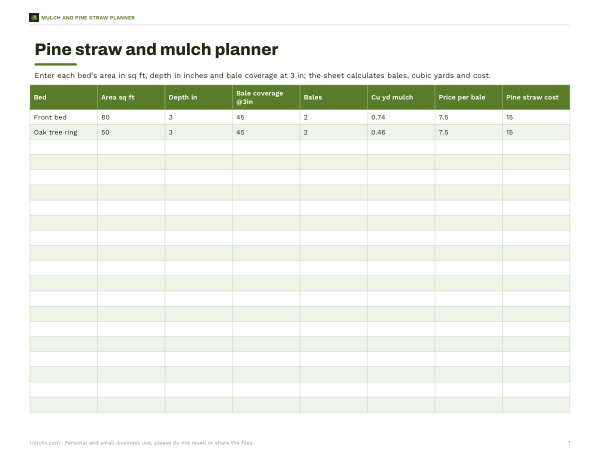
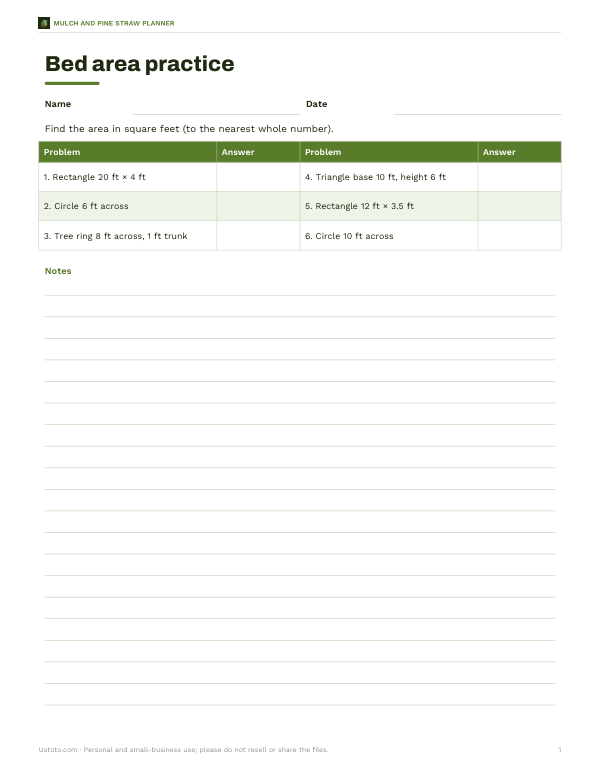
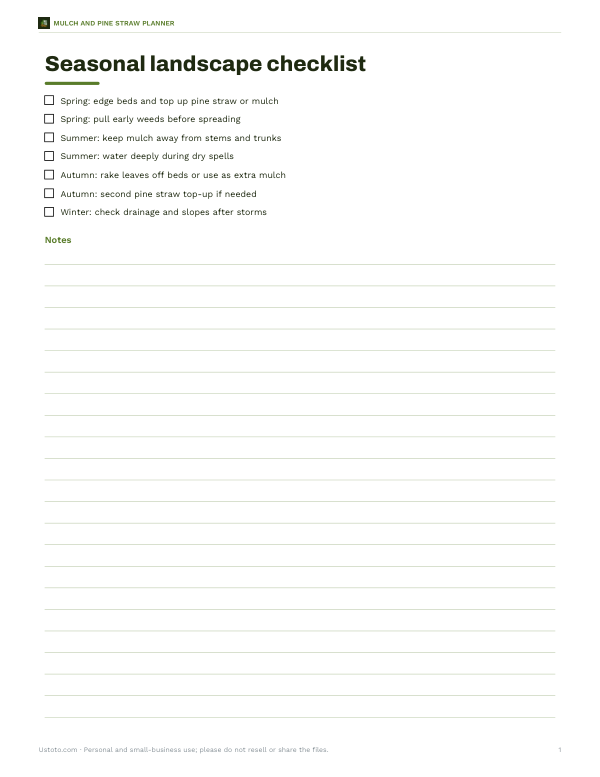
Yard mulching planner spreadsheet (areas, bales, cubic yards and cost), a bed measurement worksheet with shape formulas and a seasonal landscape maintenance checklist.
- Mulch planner (XLSX)
- Measurement worksheet (PDF/DOCX)
- Seasonal checklist (PDF/DOCX)
Formats: XLSX, PDF, DOCX. Instant download after payment (link valid 72 hours, up to 5 downloads). AI-assisted: the templates were drafted with AI help and reviewed and laid out before publishing.
$5.00 USD, one-time 3 files · about $1.67 each
- Instant download
- 7-day refund
- Secure checkout by Stripe
7-day money-back guarantee. Full refund within 7 days of purchase, even after you download.
Full refund within 7 days — see the refund policy and license.
Free printables
Single sheets you can print right now, no sign-up. The full pack adds every sheet in one download plus the editable files.
How the calculation works
- Measure each bed and work out its area: length × width for rectangles, π × radius² for circles, the outer circle minus the trunk for tree rings, and ½ × base × height for triangles.
- Add up all the areas.
- Divide by the area one bale covers at your chosen depth.
- Round up to whole bales.
Coverage figures for a bale vary by region, needle type and bale size. A commonly quoted figure is roughly 40–50 sq ft at about 3 inches deep; the calculator defaults to 45 sq ft and scales it for other depths (a thinner layer covers more, a thicker layer less).
Coverage by depth
| Depth | Coverage per bale (at 45 sq ft @ 3 in) | Bales per 100 sq ft | Bales per 1,000 sq ft |
|---|---|---|---|
| 2 in | 68 sq ft | 2 | 15 |
| 3 in | 45 sq ft | 3 | 23 |
| 4 in | 34 sq ft | 3 | 30 |
Worked example
A homeowner has a 20 × 4 ft front bed (80 sq ft), a ring around an oak tree 8 ft across with a 1 ft trunk (about 49 sq ft) and a 6 ft circle around the mailbox (about 28 sq ft) — about 158 sq ft in total. At 3 inches deep with 45 sq ft per bale, that’s 4 bales, or $30.00 at $7.50 each. The same area of wood mulch at 3 inches would need about 1.46 cubic yards. These are the calculator’s default values.
Pine straw vs wood mulch
| Pine straw | Wood mulch | |
|---|---|---|
| Weight | Very light; easy to carry and spread | Heavy |
| Slopes | Needles interlock and resist washing away | Can wash off steep slopes |
| Look | Natural, reddish-brown; fades to grey | Many colours and textures |
| Longevity | Often topped up once or twice a year | Often lasts a year or more |
| Soil | Adds organic matter as it breaks down | Adds organic matter as it breaks down |
| Fire risk | Dry straw is flammable — keep a gap from buildings in fire-prone areas | Also combustible when dry |
A common belief is that pine straw makes soil strongly acidic; in practice, the effect of mulch on soil pH is generally small, and many gardeners use it around a wide range of plants.
How to spread pine straw
- Weed and edge the beds first.
- Break open the bale and shake out loose handfuls, fluffing the needles.
- Spread evenly to about 3 inches; it settles by roughly a third.
- Tuck the edges down along borders for a neat line.
- Keep straw a few inches away from tree trunks and plant stems.
- Top up when the layer thins or fades.
Pine straw on slopes and around shrubs
On slopes, spread pine straw a little thicker at the top of the bank and work downhill; the long needles interlock as they settle, which helps hold soil in heavy rain. Around shrubs and perennials, pull the straw back a few inches from the stems so moisture doesn’t sit against the bark, and avoid piling it against tree trunks in a “volcano”. For new plantings, water well before spreading so the soil beneath starts moist.
Buying and storing bales
- Buy all your bales from one batch where possible so colour matches across beds.
- Store unopened bales off the ground and out of the rain to keep them fresh.
- Handle bales with gloves — the needles are sharp and can be dusty.
- Open bales where you need them: loose straw blows around easily.
- Order a little extra for touch-ups after storms or leaf clean-up.
Long-leaf vs short-leaf pine straw
Pine straw is usually sold as long-leaf (needles up to about a foot long) or short-leaf and slash pine (shorter needles). Long-leaf straw is often considered more attractive and longer-lasting and may cover a larger area per bale, while shorter-needle straw can be cheaper. Because bale sizes differ too, compare suppliers by the area each bale covers rather than by price per bale alone.
Measuring irregular beds
For curved or irregular beds, break the shape into rectangles, circles and triangles and add each one separately, or measure the length and average width. For a kidney-shaped bed, for example, the length times the width halfway along gives a reasonable estimate. It’s better to buy one extra bale than to run short midway through the job.
Privacy
All calculations run in your browser.
Frequently asked questions
How much does a bale of pine straw cover?
Commonly around 40–50 sq ft at about 3 inches deep; check your supplier’s figure.
How deep should pine straw be?
About 2–3 inches for top-ups and 3–4 inches for new beds.
How many bales for 1,000 sq ft?
About 23 bales at 3 inches if one bale covers 45 sq ft.
Is pine straw better than mulch?
It is lighter and stays on slopes; wood mulch usually lasts longer.
Does pine straw make soil acidic?
The effect is usually small; test your soil if you are concerned.
Can I use metres?
Yes — switch units to metres.
How often should I replace pine straw?
Many gardeners add a fresh layer once or twice a year as it fades and settles.
Should I remove old pine straw first?
Usually not — add new straw on top unless the old layer is matted or diseased.
Is pine straw safe for vegetable gardens?
Many gardeners use it as a path or row mulch; keep it clean and free of weed-killer residue.